27. Schelling Model with JAX#

27.1. Overview#

In the previous lecture, we rewrote our Schelling model using NumPy arrays and functions.

In this lecture, we explore JAX, a library developed by Google for high-performance numerical computing.

JAX offers several powerful features, including automatic GPU/TPU acceleration and just-in-time compilation.

JAX is heavily used for AI workflows but we repurpose it to work with our simulation.

Let’s start with some imports:

import matplotlib.pyplot as plt
import numpy as np
import jax
import jax.numpy as jnp
from jax import random, jit, vmap
from functools import partial
from typing import NamedTuple
import time

27.2. How JAX Differs from NumPy#

Before diving into the code, let’s understand what makes JAX special.

27.2.1. Immutable Arrays#

In NumPy, we often modify arrays in place:

# NumPy style (mutable)
locations[i, :] = new_location  # modifies the array

JAX arrays are immutable — they cannot be modified after creation. Instead, you create new arrays:

# JAX style (immutable)
locations = locations.at[i, :].set(new_location)  # returns a new array

This might seem inefficient, but JAX’s compiler can optimize these operations, often avoiding unnecessary copies.

27.2.2. Functional Programming#

JAX works best with pure functions — functions that:

  1. Always return the same output for the same input

  2. Don’t modify any external state (no side effects)

This style makes code easier to reason about and enables JAX’s powerful optimizations.

27.2.3. Random Numbers#

NumPy’s random number generator maintains hidden internal state. JAX takes a different approach: you explicitly manage random “keys”:

# NumPy style
np.random.seed(42)
x = np.random.uniform()  # uses hidden state

# JAX style
key = random.PRNGKey(42)       # create a key
x = random.uniform(key)        # pass key explicitly
key, subkey = random.split(key)  # get new keys for future use

This explicit handling makes JAX programs reproducible and parallelizable.

27.3. Parameters#

We use the same parameters as before. To keep our functions pure, we pack all parameters into a NamedTuple that gets passed to functions that need them:

class Params(NamedTuple):
    num_of_type_0: int = 1000    # number of agents of type 0 (orange)
    num_of_type_1: int = 1000    # number of agents of type 1 (green)
    num_neighbors: int = 10      # number of agents regarded as neighbors
    max_other_type: int = 6     # max number of different-type neighbors tolerated


params = Params()

27.4. Initialization#

Here’s our initialization function. Note that we use jax.random instead of numpy.random:

def initialize_state(key, params):
    """
    Initialize agent locations and types.

    """
    num_of_type_0, num_of_type_1 = params.num_of_type_0, params.num_of_type_1
    n = num_of_type_0 + num_of_type_1
    locations = random.uniform(key, shape=(n, 2))
    types = jnp.array([0] * num_of_type_0 + [1] * num_of_type_1)
    return locations, types

The key differences from NumPy are that we pass a key argument to random.uniform (making random generation deterministic and reproducible) and we pass params explicitly rather than relying on global variables.

27.5. JAX-Compiled Functions#

Now let’s rewrite our core functions for JAX. We add the @jit decorator to compile functions for faster execution.

27.5.1. Computing Distances#

@jit
def get_distances(loc, locations):
    """
    Compute squared Euclidean distance from one location to all agent locations.

    """
    diff = loc - locations  # broadcasting: (2,) - (n, 2) -> (n, 2)
    return jnp.sum(diff**2, axis=1)

Notice that we use vectorized operations like in NumPy. JAX compiles these vectorized operations very efficiently, especially when running on GPUs.

We use jnp (JAX NumPy) instead of np (NumPy). The functions are similar, but jnp operations return JAX arrays and can be compiled by JAX’s JIT compiler.

27.5.2. Finding Neighbors#

@partial(jit, static_argnames=('params',))
def get_neighbors(loc, agent_idx, locations, params):
    """
    Get indices of the num_neighbors nearest neighbors to a location (excluding agent_idx).

    Parameters
    ----------
    loc : array of shape (2,)
        The location to find neighbors for.
    agent_idx : int
        The index of the agent (excluded from neighbors).
    locations : array of shape (n, 2)
        All agent locations.
    params : Params
        Model parameters.
    """
    num_neighbors = params.num_neighbors
    distances = get_distances(loc, locations)
    # Set self-distance to infinity so agent doesn't count as own neighbor
    distances = distances.at[agent_idx].set(jnp.inf)
    # Use top_k on negated distances to find num_neighbors smallest in O(n) instead of O(n log n)
    _, indices = jax.lax.top_k(-distances, num_neighbors)
    return indices

Note that we use distances.at[i].set(jnp.inf) instead of distances[i] = jnp.inf because JAX arrays are immutable. This returns a new array with the value at index i set to infinity.

27.5.3. Checking Unhappiness#

@partial(jit, static_argnames=('params',))
def is_unhappy(loc, agent_type, agent_idx, locations, types, params):
    """
    True if an agent at loc would have too many different-type neighbors.

    Parameters
    ----------
    loc : array of shape (2,)
        The location to test.
    agent_type : int
        The type of the agent (0 or 1).
    agent_idx : int
        The index of the agent (excluded from neighbor calculation).
    locations : array of shape (n, 2)
        All agent locations.
    types : array of shape (n,)
        All agent types.
    params : Params
        Model parameters.
    """
    max_other_type = params.max_other_type
    neighbors = get_neighbors(loc, agent_idx, locations, params)
    neighbor_types = types[neighbors]
    num_other = jnp.sum(neighbor_types != agent_type)
    return num_other > max_other_type

This function takes the location and type as explicit arguments, rather than looking them up from the arrays. This design allows us to test hypothetical locations without modifying the locations array — useful when an agent is searching for a new location.

27.5.4. Moving Unhappy Agents#

This function finds a location where the agent would be happy. Rather than updating the locations array on each iteration, it tests candidate locations directly and returns only the final location.

@partial(jit, static_argnames=('params',))
def update_agent(i, locations, types, key, params, max_attempts=10_000):
    """
    Find a location where agent i is happy.

    Returns the new location and updated random key. The calling code
    is responsible for updating the locations array if the agent moved.
    """
    loc = locations[i, :]
    agent_type = types[i]

    def cond_fn(state):
        loc, key, attempts = state
        return (attempts < max_attempts) & is_unhappy(loc, agent_type, i, locations, types, params)

    def body_fn(state):
        _, key, attempts = state
        key, subkey = random.split(key)
        new_loc = random.uniform(subkey, shape=(2,))
        return new_loc, key, attempts + 1

    final_loc, key, _ = jax.lax.while_loop(cond_fn, body_fn, (loc, key, 0))
    return final_loc, key

Let’s break down the key JAX concepts here:

  1. jax.lax.while_loop: Takes three arguments:

    • cond_fn(state) — returns True to continue looping, False to stop

    • body_fn(state) — executes one iteration, returns new state

    • (loc, key) — initial state (a tuple containing location and random key)

  2. random.split(key): Since JAX random numbers are deterministic, we need to “split” the key to get new randomness. Each split produces two new keys: one to use now, one to save for later.

  3. Testing without updating: By passing loc directly to is_unhappy, we can test candidate locations without modifying the locations array. This avoids creating new arrays inside the loop, improving efficiency.

27.6. Visualization#

Plotting uses Matplotlib, which works with regular NumPy arrays. We convert JAX arrays to NumPy arrays using np.asarray():

def plot_distribution(locations, types, title):
    """
    Plot the distribution of agents.
    """
    # Convert JAX arrays to NumPy for matplotlib
    locations_np = np.asarray(locations)
    types_np = np.asarray(types)

    fig, ax = plt.subplots()
    plot_args = {'markersize': 6, 'alpha': 0.8, 'markeredgecolor': 'black', 'markeredgewidth': 0.5}
    colors = 'darkorange', 'green'
    for agent_type, color in zip((0, 1), colors):
        idx = (types_np == agent_type)
        ax.plot(locations_np[idx, 0],
                locations_np[idx, 1],
                'o',
                markerfacecolor=color,
                **plot_args)
    ax.set_title(title)
    plt.show()

27.7. The Simulation#

We separate the core simulation loop from the setup and plotting code. This makes it easier to optimize or JIT-compile the loop independently.

@partial(jit, static_argnames=('params',))
def get_unhappy_agents(locations, types, params):
    """
    Find indices and count of all unhappy agents using vectorized computation.
    """
    n = params.num_of_type_0 + params.num_of_type_1

    def check_agent(i):
        return is_unhappy(locations[i], types[i], i, locations, types, params)

    all_unhappy = vmap(check_agent)(jnp.arange(n))
    # jnp.where with size= returns fixed-length array (required for JIT)
    # Pads with fill_value=-1 when fewer than n agents are unhappy
    indices = jnp.where(all_unhappy, size=n, fill_value=-1)[0]
    count = jnp.sum(all_unhappy)  # number of valid indices
    return indices, count


def simulation_loop(locations, types, key, params, max_iter):
    """
    Run the simulation loop until convergence or max iterations.

    Returns
    -------
    locations : array
        Final agent locations.
    iteration : int
        Number of iterations completed.
    key : PRNGKey
        Updated random key.
    """
    iteration = 0
    while iteration < max_iter:
        print(f'Entering iteration {iteration + 1}')
        iteration += 1

        # Find unhappy agents using vectorized computation
        unhappy, num_unhappy = get_unhappy_agents(locations, types, params)
        num_unhappy = int(num_unhappy)

        # Check if everyone is happy
        if num_unhappy == 0:
            break

        # Update only the unhappy agents
        for j in range(num_unhappy):
            i = int(unhappy[j])
            new_loc, key = update_agent(i, locations, types, key, params)
            locations = locations.at[i, :].set(new_loc)

    return locations, iteration, key
def run_simulation(params, max_iter=100_000, seed=1234):
    """
    Run the Schelling simulation using JAX.
    """
    key = random.PRNGKey(seed)
    key, init_key = random.split(key)
    locations, types = initialize_state(init_key, params)

    plot_distribution(locations, types, 'Initial distribution')

    start_time = time.time()
    locations, iteration, key = simulation_loop(locations, types, key, params, max_iter)
    elapsed = time.time() - start_time

    plot_distribution(locations, types, f'Iteration {iteration}')

    if iteration < max_iter:
        print(f'Converged in {elapsed:.2f} seconds after {iteration} iterations.')
    else:
        print('Hit iteration bound and terminated.')

    return locations, types

The simulation loop differs from the NumPy version in several ways:

  1. Vectorized unhappiness check: We use get_unhappy_agents to identify all unhappy agents in parallel, then only process those agents

  2. We pass and receive the random key in each call to update_agent

  3. update_agent returns the new location, not the whole array

  4. We only update locations when an agent actually moves

This hybrid approach uses vectorized computation to identify unhappy agents, then processes them sequentially. As the simulation progresses and more agents become happy, fewer agents need processing each iteration.

27.8. Warming Up JAX#

JAX compiles functions the first time they’re called. Let’s warm up the functions:

# Warm up: use actual problem size to trigger compilation
# (JAX recompiles when array shapes change)
key = random.PRNGKey(42)
key, init_key = random.split(key)
test_locations, test_types = initialize_state(init_key, params)

# Call each function once to compile it
_ = get_distances(test_locations[0], test_locations)
_ = get_neighbors(test_locations[0], 0, test_locations, params)
_ = is_unhappy(test_locations[0], test_types[0], 0, test_locations, test_types, params)
_, _ = get_unhappy_agents(test_locations, test_types, params)
key, subkey = random.split(key)
_, _ = update_agent(0, test_locations, test_types, subkey, params)

print("JAX functions compiled and ready!")
JAX functions compiled and ready!

27.9. Results#

Now let’s run the simulation:

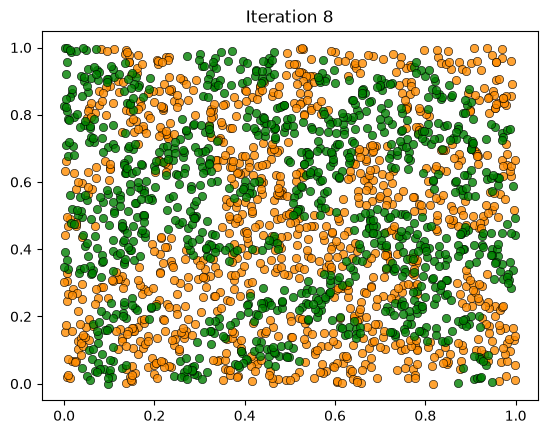
locations, types = run_simulation(params)
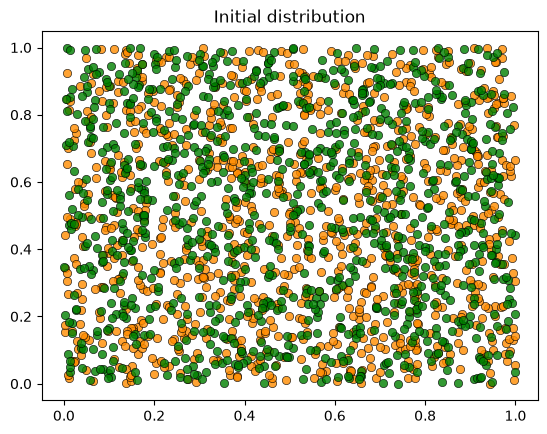
_images/d2e08faa443c919c8468559d0479722d7a404724511a4844ec158fbcf3f54437.png
Entering iteration 1
Entering iteration 2
Entering iteration 3
Entering iteration 4
Entering iteration 5
Entering iteration 6
Entering iteration 7
Entering iteration 8
Entering iteration 9
Entering iteration 10
Converged in 1.57 seconds after 10 iterations.
_images/5968201619ddb15d8e41e9a58cf22c1ab2d4cf08848cf306a60368d5bab3419f.png

27.10. Tips for Using JAX#

  1. Think functionally: Write pure functions that don’t modify external state. This makes your code easier to JIT-compile and parallelize.

  2. Use jnp instead of np: Replace NumPy operations with their JAX equivalents. Most functions have the same names.

  3. Manage random keys explicitly: Always split keys before generating random numbers. Never reuse the same key.

  4. Use JAX’s loop constructs: Replace Python for and while loops with jax.lax.fori_loop and jax.lax.while_loop inside JIT-compiled functions.

  5. Remember immutability: Use .at[].set() to “update” arrays. The original array is never modified.

  6. Warm up before timing: Always call your functions once before measuring performance to exclude compilation time.

27.11. Limitations of This Approach#

While this lecture demonstrated JAX syntax and concepts, the algorithm itself doesn’t fully leverage JAX’s parallel capabilities. The original Schelling algorithm has inherent sequential dependencies:

  • Agents update one at a time

  • Each agent’s move changes the state for subsequent agents

  • The “move until happy” while loop has unpredictable length

These characteristics don’t map well to parallel hardware like GPUs, which excel at performing the same operation on many data points simultaneously.

27.12. Summary#

JAX provides a powerful framework for accelerating Python code. Its key features are:

  • Immutable arrays that encourage functional programming

  • Explicit random key management for reproducibility

  • JIT compilation via the @jit decorator

  • GPU/TPU support for hardware acceleration

JAX’s functional style and unique capabilities like automatic differentiation and seamless GPU acceleration make it particularly valuable for machine learning and large-scale numerical computing.

To fully benefit from these capabilities, algorithms often need to be restructured for parallelism — as we’ll see in the next lecture.